
 Family & Friendships
 A New Year, a Quiet Journey, and the Companion Who Changed Everything
 December 31, 2025
 6 minute(s)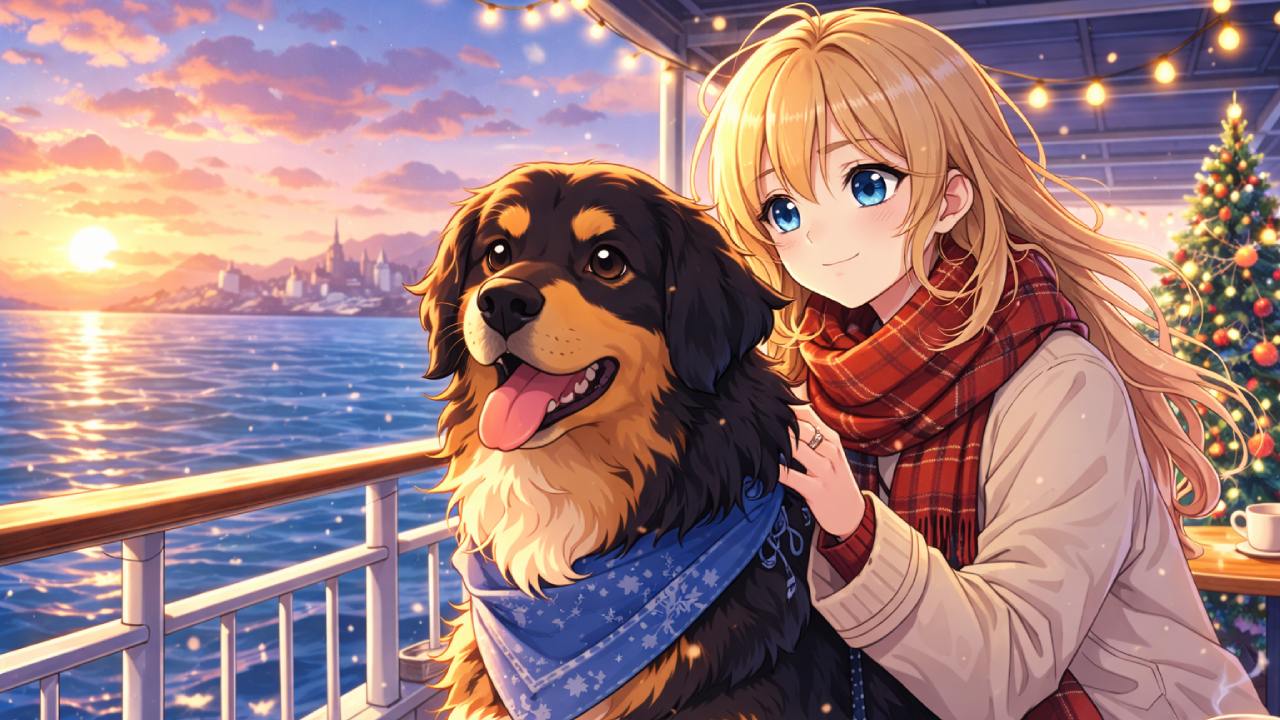
Meaningful moments don’t depend on the place you’re in. They depend on who stands next to you.
Travel has always been a part of my life. No matter the circumstances, I’ve never stopped moving. Not even a global pandemic managed to change that.
When I say “we,” I’m not speaking metaphorically. I mean myself and my loyal companion, Sir Lancelot Von Phillipsdorf.
I adopted Sir Lancelot for reasons that were far from heroic. My older dog, Oberon, was nearing the end of his life.
I knew the pain that was coming, and I tried, perhaps selfishly, to soften the inevitable loss by welcoming another dog into my life. Same rare breed. Same bloodline. A continuation.
Eventually, it was time to return to Europe. I needed to see Oberon one last time. Leaving him behind for two years had been unbearable, and I knew I had to be there when the moment arrived.
Sir Lancelot was only seven months old when he joined me in the car. Together, we began our journey from Liverpool to Harwich, where an overnight ferry would take us across to Belgium.
I had traveled alone for years, and over time I grew to resent many parts of it – endless queues, delayed flights, misplaced luggage, tense border checks, restless crowds, and the constant feeling of vulnerability. Travel often felt more exhausting than enriching.
Strangely, traveling during the pandemic felt different. Calmer. More human. We planned carefully, followed every precaution, and prepared for the worst, but we were also adaptable. Resilient.
Sir Lancelot, after all, is no ordinary dog.
He is a Hovawart, an ancient German breed that nearly disappeared from history. Mountain guardians by nature, Hovawarts were bred over centuries to protect, defend, and remain fiercely loyal to their families.
They are not widely known, but those who understand them know their power.
If Sir Lancelot were a movie character, he’d be Bryan Mills from Taken. Calm, observant, quietly intimidating when necessary.
Before we set off on our 1,200-mile journey across Europe, Lancelot received a full grooming session. A knight, after all, should look the part.
What followed was something I hadn’t expected: kindness at every step.
Traveling Through a Different World
I had anticipated judgment, harsh rules, tense encounters, and disapproval for traveling during uncertain times. The media had painted travel as reckless.
Government guidelines felt overwhelming. I braced myself for negativity.
Instead, I encountered warmth.
Border controls, once a source of stress, felt almost surreal. Officers were relaxed, conversational, even cheerful.
One admitted how quiet things had become, how they missed the flow of travelers and the sense of purpose it brought.
Many colleagues had been furloughed or lost their jobs altogether.
At one checkpoint, after checking my documents, a young officer glanced toward the backseat and joked,
“And who is the blonde lady hiding back there?”
I rolled down the window, revealing Lancelot’s oversized, fluffy head. The officer burst into laughter, slightly embarrassed.
“Well, that explains everything. You’re free to go.”
I had never experienced border control like that before – human, light, almost friendly.
Traveling with a dog somehow dissolved suspicion instead of creating it.
The Ghost Ship and Unexpected Kindness
At the ferry terminal, procedures were swift.
No queues.
My COVID test was checked, and Lancelot’s microchip scanned.
He, however, was far more interested in marking his territory.
I apologized, joking that quarantine had made him forget his manners.
What I didn’t mention was our habit of dancing together to the Dirty Dancing soundtrack – jumping and hugging had become second nature to him.
When I was told that Lancelot was considered an oversized puppy and would need to stay in a kennel, despite my dog-friendly cabin booking, I was crushed.
Then came a small miracle.
I was told to find a man named Miguel.
Once aboard the ferry, staff greeted us warmly, offering help with luggage, explaining the onboard amenities, and thanking me for being one of only a handful of passengers on what felt like a deserted ship.
When I asked to speak to Miguel, the man guiding me smiled.
“You already are.”
Miguel personally escorted us to a cabin – small, but enough to keep Lancelot out of the kennel.
Seeing my dog’s disappointment at the fake window, Miguel promised to check for alternatives.
Fifteen minutes later, he returned with good news: a larger cabin, free of charge.
Miguel had worked on the ferry for sixteen years. In a month, he would lose his job. The pandemic had stripped many of his colleagues of their livelihoods, their motivation, and their sense of direction.
We exchanged contact details, hoping to stay in touch.
At one point, while we were talking, Lancelot had an accident.
Miguel laughed harder than I’d ever seen someone laugh.
“I needed this,” he said. “Thank you.”
Our new cabin was spacious, comfortable, and quiet. In normal times, none of this would have happened.
But these were not normal times.
That evening, the ship felt like it belonged to us alone.
The restaurants were empty. The kitchen had closed – but reopened when staff saw Lancelot at my side. We were seated by a window, candlelight flickering, Frank Sinatra playing softly in the background.
Returning Home Without Feeling Alone
While the world struggled, we drifted across the North Sea, sharing a meal in complete stillness.
Later that night, Lancelot attempted to use the designated dog area, only to dismantle a decorative tree instead.
We tried.
By morning, we arrived in Belgium and continued our journey by car, choosing a scenic castle route through Europe.
One fortress after another passed by, medieval towns unfolding like pages from history.
As we crossed into Germany, his ancestral land, I couldn’t help but feel that Lancelot recognized something familiar. Hovawarts once guarded castles.
Their very name means “guardian.”
He watched the landscape intently, as if returning home.
We drove for hours with minimal stops, the roads nearly empty.
When we finally arrived at our destination late that evening, I felt refreshed instead of exhausted.
The Companion Who Changes the Journey
For the first time, travel wasn’t about chaos or distraction. It was about presence.
I’ve traveled alone through more than forty countries, yet many memories blur together – defined more by inconvenience than meaning.
This journey was different.
There was nothing pulling my attention away from what mattered.
I realized then that I no longer wanted to travel alone.
Since that day, Sir Lancelot and I have discovered that meaningful journeys aren’t measured by miles, but by presence, connection, and growth.
What truly matters isn’t how far we travel, but who stands beside us and how we show up for ourselves along the way.
And that idea doesn’t only apply to the road.
Whether you’re exploring new places or navigating inner landscapes, having the right companion makes all the difference.
For some, that companion might be a loyal friend or a trusted partner; for others, it might be the tools that help you heal, reflect, and grow.
One such tool that many people find helpful on their personal journey is Chaptly, an AI-guided emotional healing app designed to support you through reflection, resilience building, and self-discovery with daily interactive quests and guided experiences.
It won’t replace the deep bonds you share with the ones beside you, but it can be a valuable companion in strengthening your inner world – reminding you to be present, honest, and curious about who you are becoming.
Because special moments – whether on the road or within yourself – are shaped not just by where you go, but by how fully you embrace the journey and those you choose to walk it with.
 Be the First to
Get Chaptly App


- share
-

-

-

-

-