
 Work-Life Balance & Identity Crisis
 You’re Exhausted but Can’t Sleep? [5 Steps to Break the Cycle]
 January 31, 2026
 6 minute(s)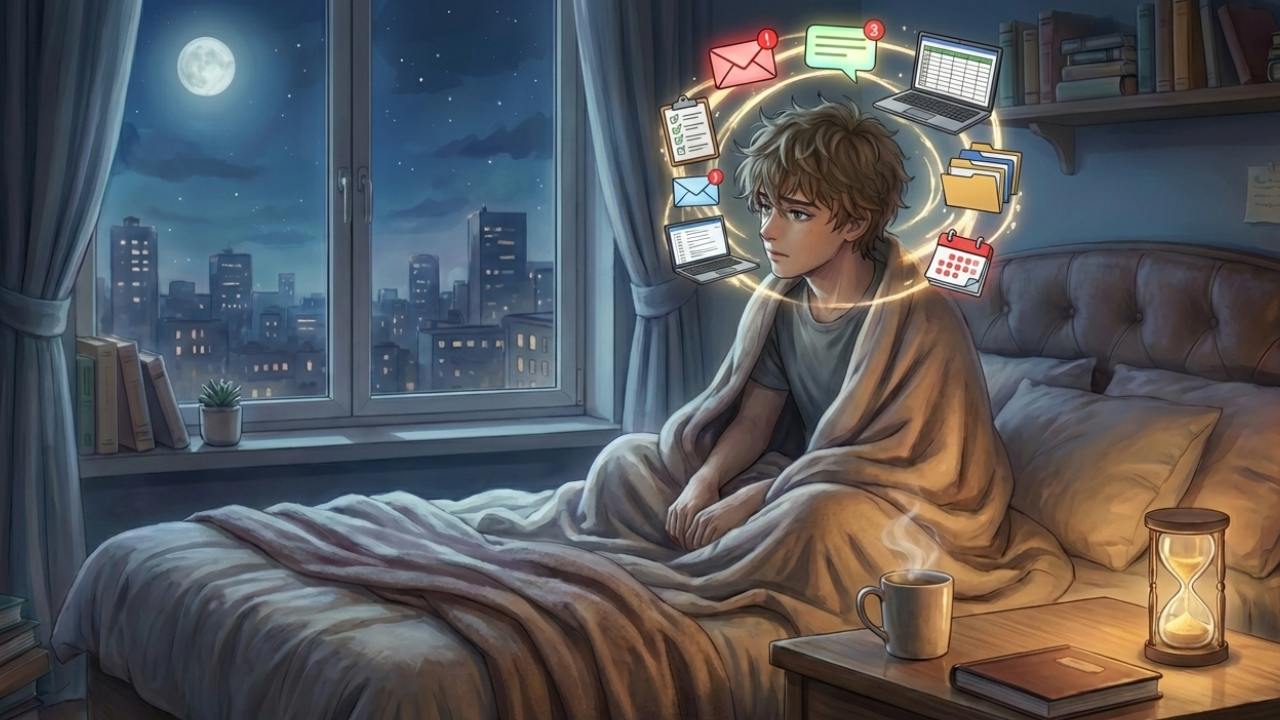
You’re exhausted, not just physically, but deeply. The kind of tiredness that settles into your bones and makes even simple tasks feel heavy.
And yet, when it’s finally time to rest, your body doesn’t cooperate. Your mind keeps moving. Your chest stays tight. Sleep feels distant, even though you need it desperately.
If this is your experience, nothing is “wrong” with you.
For many people, exhaustion without rest is not a failure of discipline or routine. It’s a sign that your nervous system has learned to stay alert – even when there is no immediate danger.
By continuing to read, you’ll understand why rest can feel unsafe, how past conditioning shapes your relationship with slowing down, and how to begin creating space for real recovery without forcing your body or silencing yourself.
Stay tuned.
Why Exhaustion Doesn’t Automatically Lead to Rest
We’re often taught that exhaustion should naturally lead to sleep. But for a nervous system shaped by prolonged stress, pressure, or emotional unpredictability, the opposite can happen.
When you’ve spent years needing to stay “on”, emotionally available, productive, responsible, or strong, your body adapts.
Alertness becomes the default. Slowing down feels unfamiliar. Sometimes it even feels threatening.
Rest creates quiet. Quiet creates space. And space can bring up thoughts, memories, or emotions that were easier to manage while staying busy.
So instead of relaxing, your system stays vigilant. Not because it’s broken – but because it learned that staying alert was once necessary.
So how to break this cycle and come back to “normal”?
Step 1: Understand the Root Cause
Awareness is the foundation of change. Before trying to “fix” your sleep or energy levels, pause and ask yourself a few honest questions:
- Why do I feel uneasy or guilty when I stop?
- What do I fear might happen if I truly rest?
- Do I associate rest with falling behind, being judged, or losing control?
For many people, rest subconsciously triggers anxiety. Silence creates space and space allows unresolved emotions, doubts, or memories to surface.
Staying busy becomes a way to avoid discomfort rather than a genuine choice.
Identifying these mental blocks doesn’t mean blaming yourself. It means recognizing that your struggle with rest once served a purpose – and now deserves a gentler update.
Step 2: Use Micro-Breaks to Rewire Your Nervous System
When rest feels difficult, advice like “just unwind” or “try harder to sleep” can feel frustrating or even invalidating.
Relaxation is not something you can command when your nervous system is activated.
If full rest feels impossible, don’t aim for it yet.
Start small. Your nervous system learns through repetition, not force.
Micro-breaks can be as brief as three to five minutes, and they work because they send a powerful signal: It’s safe to pause.
Try simple practices like:
- Slow, intentional breathing
- Gentle stretching or shaking out tension
- Sitting quietly without stimulation
- Looking out a window or focusing on one calming object
The goal isn’t relaxation – it’s permission. Over time, these small pauses retrain your body to tolerate stillness without panic.
As safety increases, longer periods of rest become naturally accessible.
Step 3: Design an Environment That Encourages Rest
Your nervous system is constantly responding to cues around you. Light, sound, screens, notifications, and unfinished tasks all communicate whether it’s time to stay alert or to soften.
Reducing stimulation in the evening, creating predictable routines, and allowing your surroundings to feel less demanding can support rest without effort.
To create a rest-friendly space:
- Dim lights in the evening
- Silence nonessential notifications
- Put physical distance between you and work-related items
- Establish a gentle pre-rest routine (same time, same signals)
You don’t need a perfect setup. Consistency matters more than aesthetics.
When your environment stops asking things of you, your body slowly follows.
Step 4: Practice Mindful Self-Compassion
One of the quiet reasons people struggle to rest is internal pressure. A voice that says you should be doing more. That rest is indulgent. That slowing down must be earned.
One of the biggest barriers to rest is harsh self-talk.
- “You should be able to handle this.”
- “Others do more, why can’t you?”
- “Rest is a reward, not a right.”
Trauma-informed care recognizes that self-criticism keeps the nervous system in defence mode. Compassion, on the other hand, creates room to settle.
Rest is not a reward. It’s a biological need. And offering yourself permission, without justification, is a powerful step toward real recovery.
Step 5: Set Boundaries That Protect Your Energy
If exhaustion is chronic, chances are your boundaries are being crossed – sometimes by others, often by yourself.
Boundaries are not about pushing people away. They’re about creating enough safety for your body to stand down.
Saying no, delaying commitments, or allowing yourself to be less available can feel uncomfortable, especially if you’re used to being needed.
But safety is what allows rest. Without it, the body stays alert, no matter how tired it is.
Rest Is Not Laziness, It’s Self-Preservation
Learning how to rest when your nervous system resists it can feel isolating. Especially if you’ve spent years being functional on the outside while feeling depleted inside.
Support doesn’t always have to look like traditional therapy. Sometimes it begins with having a space where you can slow down, reflect, and feel understood without pressure.
This is where tools like Chaptly can be helpful. Not as a fix, but as a companion – a place to gently explore what’s happening internally, at your own pace, in a way that respects your nervous system rather than pushing against it.
Instead of pushing your nervous system to relax, it helps you understand why it’s holding on.
Through guided reflections, emotionally safe prompts, and a tone rooted in compassion rather than productivity, Chaptly supports the process of reconnecting with your inner state – especially when silence or stillness feels difficult.
It acknowledges that rest isn’t just physical. It’s emotional. It’s relational. And it often starts with feeling understood.
You don’t have to unpack everything at once. You don’t have to explain yourself perfectly. And you don’t have to reach some ideal state of calm.
If you’re exhausted but can’t sleep, your body isn’t failing you. It’s communicating.
By listening instead of overriding, by choosing gentleness over force, and by allowing support rather than isolation, you begin to shift from survival into restoration.
Rest, in this sense, is not an achievement.
It’s a relationship – with your body, your limits, and your inner world.
And with the right support, that relationship can slowly, safely change.
- share
-

-

-

-

-